Noida, India · ISO 9001:2015 certified
Hexagonal Boron Nitride (h-BN) Products
Pyroflux India offers the complete h-BN range — powder, aerosol spray, suspensions, wax sticks and machined boron nitride ceramics — for foundries, aluminium extruders, high-temperature furnaces, coatings formulators and electronics manufacturers. Standard grades ship from stock; custom formulations and machined shapes are made to your drawing.
Not sure which product you need? Use the selection guide ↓
Product range
Five forms of hexagonal boron nitride, one supplier
The same high-purity h-BN, supplied in whichever form suits your process — dry powder for compounding, sprays and suspensions for tooling, wax sticks for hot dies, and fully dense machined ceramics for the melt itself.
h-BN Powder
High-purity hexagonal boron nitride powder for compounding, thermal fillers and dry lubrication.
- 99%+ purity
- Particle sizes from 3 µm to 50 µm
- 1 kg, 5 kg, 10 kg and bulk packs
h-BN Spray
Ready-to-use aerosol for fast, even release coatings on dies, moulds, nozzles and fixtures.
- 500 mL / 300 g aerosol cans
- No mixing, no dilution, no brush marks
- Ideal for touch-up and small-area coating
h-BN Suspension
Water-, oil- and solvent-based BN suspensions and pastes for spraying, brushing or dipping.
- BN solids typically 5–25%
- Paste grades up to 40% solids
- 1 kg to 200 kg packs
h-BN Wax Sticks
Solid BN sticks applied directly to hot tooling — no spray equipment, no overspray, no waste.
- Applied to surfaces at working temperature
- Melts and spreads without running or dripping
- Dummy blocks, billet ends, dies and shears
h-BN Ceramics
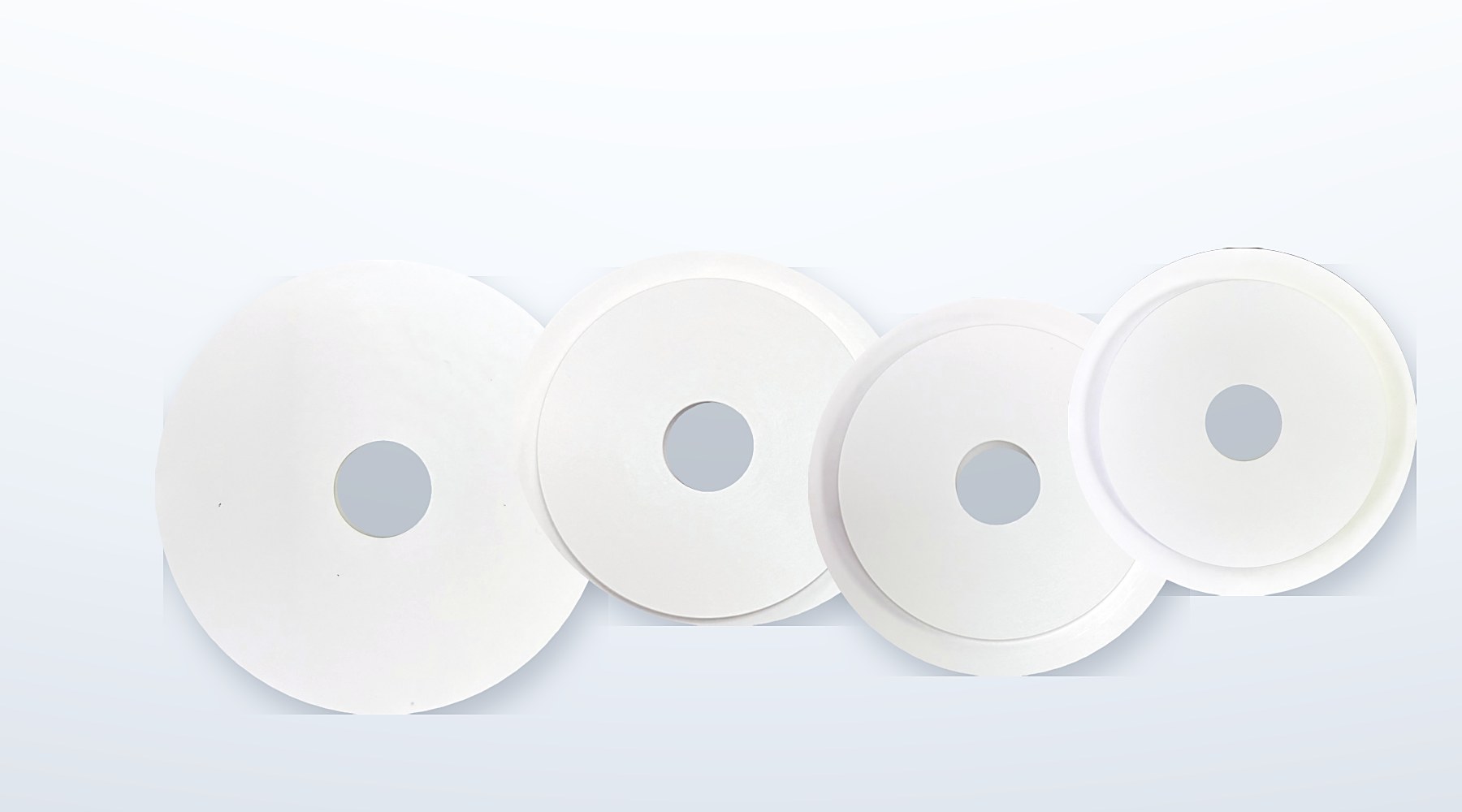
Machined boron nitride crucibles, nozzles, rings, setter plates and custom shapes to your drawing.
- Fully machinable — tight tolerances
- Not wetted by molten aluminium or glass
- Prototype quantities through production
Custom formulations
Tell us the substrate, the process temperature and the atmosphere. We formulate to the application rather than selling you the nearest catalogue item.
- Carrier system matched to your process
- Solids content and particle size to suit
- Private-label and bulk supply available
Product 01
Hexagonal Boron Nitride Powder
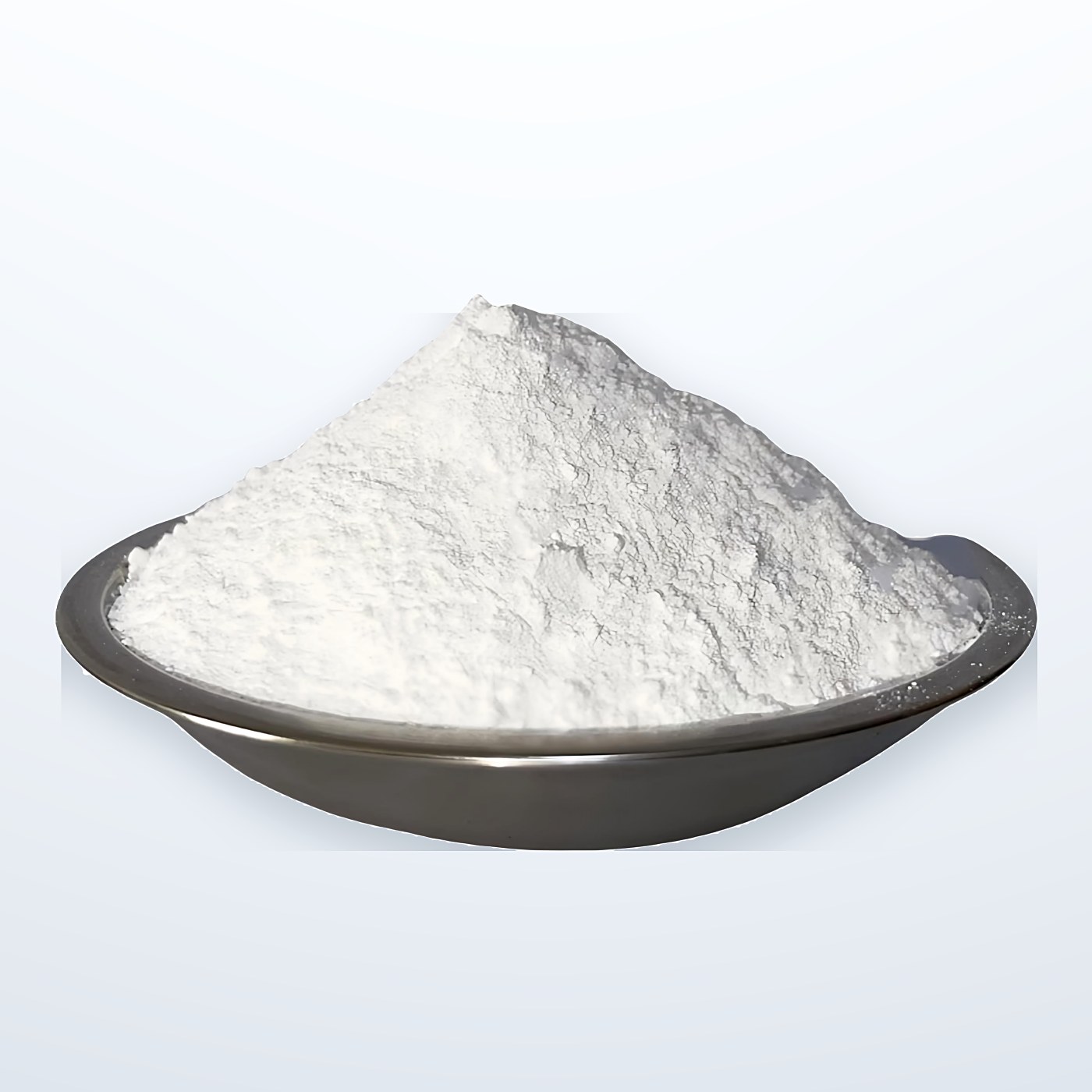
The h-BN powder we supply is a white, lamellar, chemically inert solid often called white graphite. It lubricates like graphite but leaves no carbon behind, keeps working in vacuum and inert atmospheres, and resists oxidation to far higher temperatures. That combination makes it the default choice wherever a black carbon-based lubricant would contaminate the part.
We stock it loose for direct use as a dry lubricant and mould dust, and as a functional filler for thermally conductive but electrically insulating compounds — thermal interface materials, potting resins, greases and engineering plastics.
| BN content | 99% minimum |
|---|---|
| Particle size (D50) | Grades from 3 µm to 50 µm |
| Appearance | White, free-flowing lamellar powder |
| Pack sizes | 1 kg, 5 kg, 10 kg, 25 kg and bulk |
| Typical uses | Thermal interface materials, thermally conductive plastics, high-temperature greases, mould dusting, dry lubrication |
Product 02
Boron Nitride Aerosol Spray
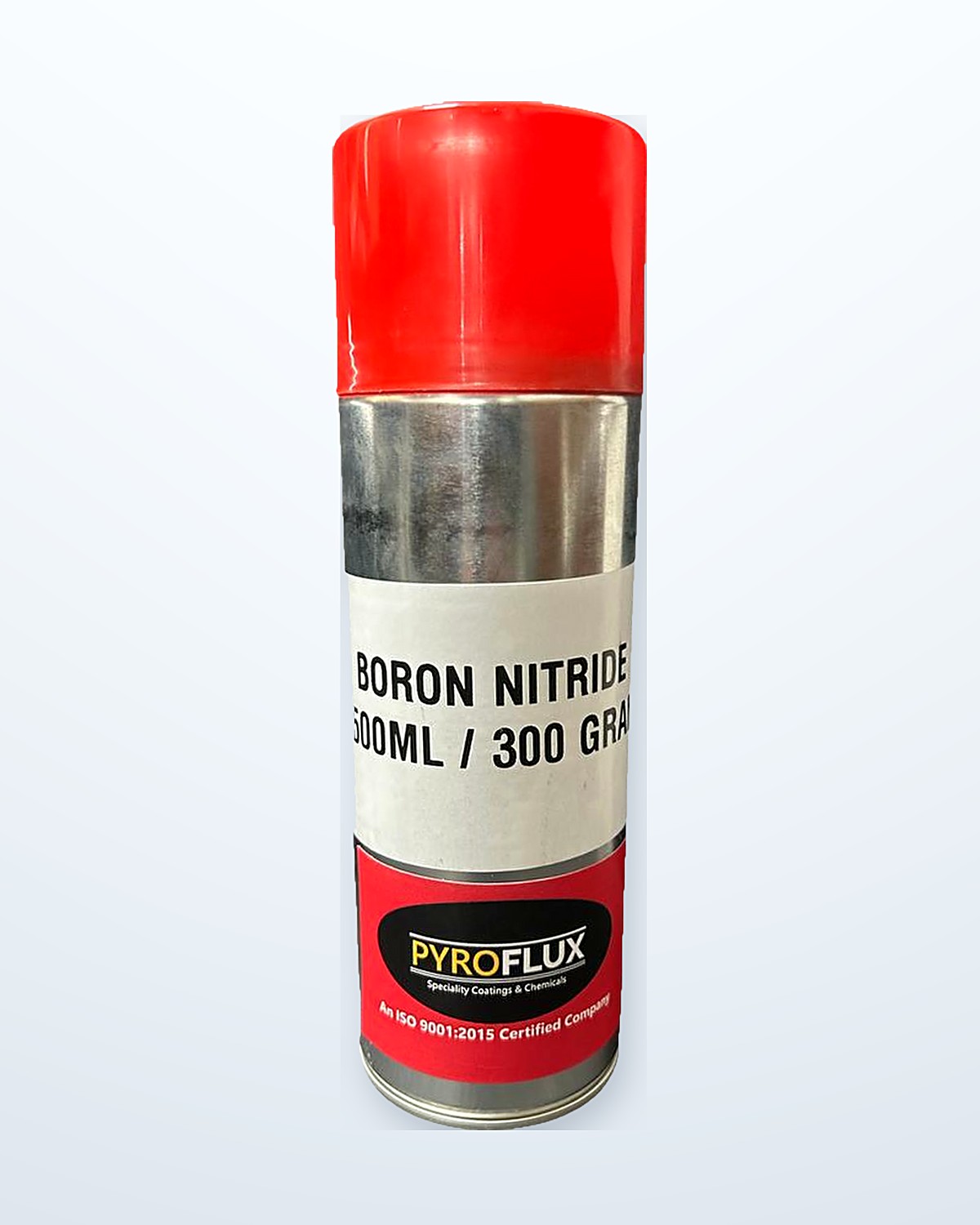
A ready-to-use aerosol that lays down a thin, even h-BN release film in seconds. There is nothing to weigh, stir or dilute, and no brush marks — which is exactly what you want for touch-ups between shots, for awkward geometry, and for anyone on the shop floor who is not a coatings technician.
Typical duties are die and mould release, protecting thermocouple sheaths and furnace fixtures, stopping weld spatter adhesion, and preventing molten aluminium from wetting tooling. Shake, spray a light even pass, allow the carrier to flash off, and the surface is ready.
| Form | Aerosol, ready to use — no dilution |
|---|---|
| Pack size | 500 mL can, 300 g net |
| Coating colour | White |
| Service temperature | Up to approx. 900 °C in air; approx. 1400 °C in vacuum; approx. 1800 °C in inert gas† |
| Typical uses | Die and mould release, weld spatter release, furnace fixtures, thermocouple protection, glass forming tools |
† Service temperature depends on atmosphere, substrate and film thickness. h-BN begins to oxidise in air at roughly 850–900 °C; the higher figures apply only in vacuum or inert atmospheres. Ask us for the temperature rating that applies to your specific process.
Product 03
Boron Nitride Suspensions, Coatings & Pastes
Where the spray is about convenience, the suspensions are about control. These are h-BN dispersions in water, oil or solvent carriers, supplied at a solids content you can spray, brush, roll or dip, and diluted to suit the film thickness you need. They are the workhorse for coating large areas: launders, troughs, ladles, dies, moulds, crucibles and furnace hardware.
Water-based grades are the usual starting point for foundry and extrusion work. Oil- and solvent-based grades suit substrates that cannot see water, or processes where fast drying matters. Paste grades at higher solids are used where a thick, durable barrier is wanted rather than a thin film.
| Carrier systems | Aqueous, oil-based and solvent-based |
|---|---|
| BN solids content | Typically 5–25% for sprayable grades; up to 40% in paste form |
| Application | Spray, brush, roller or dip; dilute to suit film thickness |
| Pack sizes | 1 kg to 200 kg |
| Typical uses | Launders and troughs, ladles, die casting, mould coating, extrusion tooling, brazing fixtures |
Product 04
Boron Nitride Wax Sticks
Wax sticks solve a specific problem: how do you lubricate tooling that is already hot and already in the press? A liquid coating flashes off or runs. A stick does not. The operator simply wipes the stick across the hot surface; it melts on contact and leaves an even h-BN film exactly where it was applied.
In aluminium extrusion this is the standard method for dummy blocks, billet ends, press shears and container seals. There is no spray equipment to maintain, no overspray to clean up, and no compressed air. It is also the cheapest way to trial h-BN in an existing process, because nothing about the line has to change.
| Form | Solid stick — h-BN dispersed in a high-temperature wax binder |
|---|---|
| Application | Wiped directly onto tooling at working temperature; melts and spreads without running |
| Binder behaviour | Wax burns off cleanly, leaving the h-BN film in place |
| Typical uses | Aluminium extrusion dummy blocks, billet ends, press shears, container seals, forging and hot-working dies |
| Supplied as | Individual sticks and cartons — contact us for current sizes |
Product 05
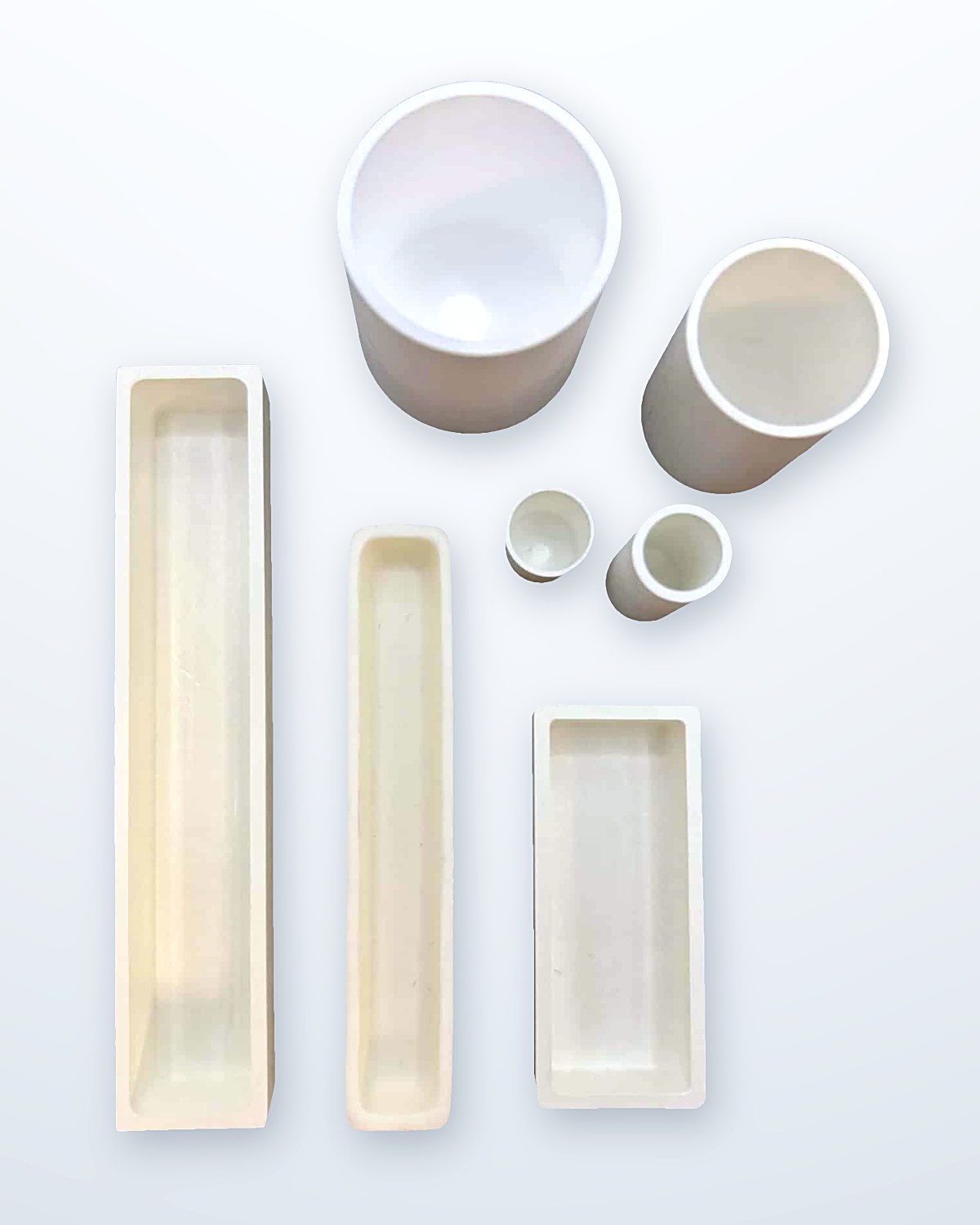
Boron Nitride Ceramics — Crucibles, Nozzles & Custom Shapes
Hot-pressed h-BN is one of the very few ceramics you can machine on conventional equipment with ordinary carbide tooling. That means real components — crucibles, nozzles, break rings, setter plates, sleeves, spacers, insulators — can be produced to a drawing in prototype quantities without the tooling cost of a pressed part.
In service the material does what no metal can: molten aluminium, glass and most slags will not wet it, it is an excellent electrical insulator while still conducting heat well, and its near-zero net thermal expansion lets it be quenched and cycled without cracking. Send us a drawing or a sample and we will quote the part.
| Standard shapes | Crucibles, nozzles, rings, discs, plates, rods, sleeves, bushes |
|---|---|
| Custom work | Machined to your drawing or sample; prototype through production volumes |
| Key behaviour | Not wetted by molten aluminium, glass or most slags; excellent thermal shock resistance; electrically insulating |
| Related products | TiB₂-BN evaporation boats for vacuum metallization |
Industries served
Where our h-BN goes to work
Hexagonal boron nitride turns up wherever something hot has to not stick, not conduct electricity, or not contaminate the part. These are the sectors we supply most.
Metal Foundries
Launders, troughs, ladles, dies and moulds. Molten metal releases cleanly instead of sticking or dissolving the tooling.
Aluminium Extrusion
Dummy blocks, billet ends, dies, press shears and container seals — the classic wax stick and suspension application.
High-Temperature Applications
Furnace hardware, sintering setters, thermocouple sheaths and heat-treatment fixtures running well beyond graphite's limits.
Paints & Coatings
h-BN as a functional pigment and additive for heat-resistant, low-friction and dielectric coating systems.
Metallization Film
Vacuum web coating for packaging and capacitor film, including our TiB₂-BN evaporation boats and BN coatings.
Semiconductors
Crystal growth hardware, insulating and non-contaminating fixtures, and high-purity components for clean processes.
Thermal Pastes & TIMs
h-BN filler that moves heat away from the die while staying electrically insulating — greases, gap fillers and pads.
Glass, Brazing & Forging
Glass forming tools, aluminium brazing fixtures and hot forging dies where nothing may stick and nothing may contaminate.
Material properties
Why engineers specify hexagonal boron nitride
h-BN has a layered structure much like graphite, which is where the nickname white graphite comes from. The layers shear easily, giving excellent lubricity — but unlike graphite it carries no carbon, keeps working in vacuum and inert atmospheres, and resists oxidation to far higher temperatures.
| Property | Typical value | What it means in practice |
|---|---|---|
| Maximum service temperature | ≈850–900 °C in air ≈1400 °C in vacuum 1200–2000 °C in inert gas (grade dependent) |
Atmosphere matters more than temperature. Oxidation in air begins around 900 °C; in nitrogen or argon the material goes far higher. |
| Thermal conductivity | Strongly anisotropic. Hot-pressed parts typically 11–130 W/m·K depending on grade and direction | Moves heat away from the working face, which is why it doubles as both a release layer and a thermal management filler. |
| Electrical behaviour | Volume resistivity >10¹³ Ω·cm; dielectric strength up to ≈88 kV/mm for high-purity hot-pressed grades | Thermally conductive and electrically insulating — an unusual pairing, and the whole basis of the TIM market. |
| Hardness | Mohs ≈2–2.5 (soft, graphite-like) | Will not abrade your dies, moulds or extrusion tooling. Note this is hexagonal BN — cubic BN is the hard, abrasive form. |
| Thermal expansion | Very low net expansion; near-zero for machinable hot-pressed grades | Parts tolerate repeated thermal cycling and quenching without cracking. |
| Density | ≈2.1–2.3 g/cm³ for the material; 1.9–2.3 g/cm³ typical for hot-pressed parts | Roughly half the density of alumina — lighter fixtures, lower thermal mass, faster cycling. |
| Wetting by molten metal | Not wetted by most molten metals, slags or glass | The core reason it works as a release agent and crucible material for aluminium and glass. |
| Chemical stability | Inert to most acids at room temperature; attacked slowly by hot concentrated acids | Non-toxic, non-contaminating and stable — suitable for high-purity and clean processes. |
Property values are indicative of hexagonal boron nitride as a material class and are compiled from published technical literature. For a specification covering a particular Pyroflux grade, please request the technical data sheet.
Selection guide
Which h-BN product does your job need?
Most enquiries come down to three questions: how big is the area, how hot is it when you apply, and do you have spray equipment? This table is the short answer.
| If you need to… | Use | Why |
|---|---|---|
| Lubricate a dummy block or billet end that is already hot | h-BN Wax Stick | Applied by hand at working temperature. No equipment, no overspray, nothing to change on the line. |
| Coat a large launder, trough, ladle or mould | h-BN Suspension | Sprayed, brushed or dipped, and diluted to the film thickness you want. Most economical per m². |
| Touch up a die between shots, or coat awkward geometry | h-BN Spray | Ready to use, even film in seconds, no mixing and no brush marks. |
| Make a compound conduct heat without conducting electricity | h-BN Powder | Functional filler for TIMs, potting resins, greases and thermally conductive plastics. |
| Hold, pour or shape molten metal without it sticking | h-BN Ceramics | Machined crucibles, nozzles and rings — the solid material rather than a film on someone else's substrate. |
| Evaporate aluminium in a vacuum web coater | TiB₂-BN evaporation boats | Two-component composite boats designed for uniform heating and minimal spitting. |
| Replace graphite that is burning off or leaving carbon marks | Any h-BN form | Graphite oxidises away below about 500 °C in air; h-BN keeps going to roughly 900 °C and leaves no carbon behind. |
Frequently asked
Hexagonal boron nitride — common questions
What is the difference between hexagonal (h-BN) and cubic (c-BN) boron nitride?
They are the same compound in two different crystal structures, with almost opposite properties. Hexagonal BN has a layered, graphite-like structure and is soft — around 2 on the Mohs scale — which makes it a high-temperature solid lubricant and release agent. Cubic BN has a diamond-like structure and is among the hardest materials known, used for cutting tools and abrasives. Every product on this page is hexagonal BN.
What is the maximum temperature boron nitride can withstand?
It depends entirely on the atmosphere, so always tell us yours. In air, useful service is limited to roughly 850–900 °C, where oxidation begins. In an inert atmosphere such as nitrogen or argon, hot-pressed grades run from about 1200 °C up to 2000 °C depending on grade. In vacuum, around 1400 °C is the commonly cited limit.
Why choose boron nitride over graphite as a high-temperature lubricant?
Graphite oxidises and burns away below about 500 °C in air, while h-BN resists oxidation to roughly 900 °C. h-BN also keeps its lubricity in vacuum and inert atmospheres, where graphite loses effectiveness. And because it is white and carries no carbon, it leaves no black staining or carbon pickup on the workpiece — which matters a great deal in aluminium, glass and semiconductor work.
Is boron nitride wetted by molten aluminium?
No. h-BN is not wetted by most molten metals, and it also resists wetting by slags and molten glass. That is precisely why it works as a release agent and as a crucible material for aluminium melting, die casting and extrusion — the molten metal will not stick to or dissolve the coated surface.
How do I apply an h-BN coating or suspension?
Suspensions can be sprayed, brushed, rolled or dipped. Gently preheating the substrate improves adhesion. Build the coating in thin, even layers rather than one heavy pass, and let each layer dry before the next. Concentrated grades need diluting before use; ready-to-apply grades and the aerosol do not. Our aerosol spray needs nothing but a shake and a light even pass.
Which particle size of h-BN powder should I choose?
As a general rule the largest particle should not exceed the thickness of the finished coating or part. Coarser grades tend to give better thermal performance in filled compounds; finer grades give smoother coatings, thinner films and better surface coverage for lubricant and release duties. Tell us the film thickness or the bond line you are working to and we will recommend a grade.
Do you supply custom formulations and machined shapes?
Yes — this is most of what we do. For liquids we match the carrier system, solids content and particle size to your substrate, process temperature and atmosphere. For ceramics we machine crucibles, nozzles, rings, plates and custom geometry from your drawing or a sample part, in quantities from prototypes upward.
How should h-BN powder and components be stored?
Keep material in its original, tightly sealed packaging in a dry place — h-BN readily absorbs atmospheric moisture, and moisture shortens the working life of parts at temperature. Solid BN components are best cleaned dry, using wipes or fine abrasive paper rather than liquids.
What pack sizes and minimum order quantities do you offer?
Powder is supplied in 1 kg, 5 kg, 10 kg, 25 kg and bulk packs. Suspensions run from 1 kg to 200 kg. Sprays are 500 mL / 300 g aerosol cans. Ceramic components are quoted per part, including one-off prototypes. Contact us with your requirement and we will confirm availability and lead time.
Do you export outside India?
Yes. We are based in Noida, Uttar Pradesh and supply customers both within India and overseas. Send us your destination and quantity and we will quote with packing and documentation included.
Talk to us
Tell us the process — we will recommend the grade
Substrate, process temperature, atmosphere and how you would prefer to apply it. That is everything we need to point you at the right h-BN product, send a sample, or quote a machined part from your drawing.
Pyroflux India
An ISO 9001:2015 certified company
- Phone
- +91 98181 87838
- sales@pyrofluxindia.com
- Works
- G-5, Sector 63,
Noida 201301, Uttar Pradesh, India
Pyroflux India — speciality coatings, lubricants and chemical preparations. Related product ranges: die release agents, forging lubricants, mould coatings, high-temperature products, TiB₂-BN evaporation boats.